
Did Missouri Lawmakers Pass a School Choice Bill? MO Scholars in Plain English
If you’ve heard about MO Scholars but aren’t quite sure what it is, this guide is for you.
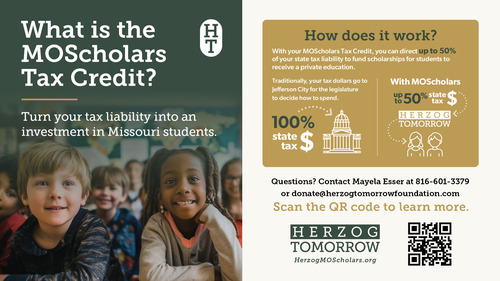
For more information or assistance with applications for either school scholarships, or Missouri income tax credits, you can contact Mayela Esser at the Herzog Tomorrow Foundation at 816-601-3379 or scan this QR code:
MO Scholars—formally the Missouri Empowerment Scholarship Accounts (ESA) Program—turns private donations into K–12 scholarships for eligible Missouri students. Donations are encouraged with state income tax credits. Recent legislation expanded the program, and the 2025–26 school year brings updated income thresholds and award amounts. (treasurer.mo.gov)
The program in one minute
- Donors (individuals or businesses) give to certified Educational Assistance Organizations (EAOs) and receive a Missouri income tax credit equal to 100% of the donation, up to 50% of the donor’s Missouri income tax liability. Unused credits can be carried forward four years. Minimum donation: $500. (Credits must be reserved before donating, then funded within 30 days.) (treasurer.mo.gov)
- Families apply through EAOs. If awarded, they receive a scholarship account to pay for tuition at eligible schools and other approved educational expenses (tutoring, therapies, curriculum, technology, transportation, and more).
What changed recently?
1) Bigger statewide cap on tax credits
The maximum pool of available MO Scholars tax credits increased from $50 million to $75 million annually. Going forward, that cap will adjust with Missouri’s school funding formula. This change enables more private donations and, ultimately, more scholarships. (Missouri Senate)
2) Statewide student access
Originally limited to certain geographies, MO Scholars eligibility is now statewide (subject to the statutory criteria below). The State Treasurer’s Parent Handbook (2025–26) reflects this broader reach and the current, plain-language rules families follow to apply and use funds.
3) Updated income pathway & award amounts
For 2025–26, Missouri ties income eligibility to 300% of the federal “reduced-price school meal” income line, which USDA updates each year (July 1–June 30). For a family of four, the 2025–26 reduced-price line is $59,478, so the MO Scholars cap is $178,434 (3×). Award maximums are also set relative to Missouri’s State Adequacy Target (SAT)—$7,145 for 2025–26—with higher caps for students with specific needs. (OSPI)
Note: In FY26, lawmakers also appropriated general revenue to expand the number of scholarships beyond what donations alone would support; that appropriation is currently the subject of litigation and does not change the donor tax-credit rules. (KCUR, KSMU)
Who can get a scholarship? (Eligibility, simply explained)
A student must be a Missouri resident and qualify by either the special-needs path or the income path.
A) Special-needs path
The student has an IEP or qualifying ISP under IDEA (dated within the last 36 months). Students diagnosed with dyslexia are specifically prioritized in the funding order.
B) Income path
The household’s income is at or below 300% of the reduced-price meals line and the student either:
- attended a Missouri public school for at least one semester in the last 12 months, or
- is entering kindergarten or first grade, or
- is a sibling of a renewing scholarship recipient.
When demand exceeds available funds, awards are made in a priority order: renewals first, then siblings, then IEP/dyslexia, then students meeting free/reduced-lunch criteria in certain districts, followed by other categories.
How much can a student receive?
For 2025–26, Missouri’s State Adequacy Target (SAT) is $7,145. Annual maximum award amounts are:
- IEP/ISP (IDEA): up to 175% of SAT → $12,504
- Limited English Proficiency (LEP): up to 160% of SAT → $11,432
- Free/Reduced-Price Lunch eligible: up to 125% of SAT → $8,931
- All other eligible students: up to 100% of SAT → $7,145
Families spend through a controlled digital wallet system, and EAOs must approve each expense against the “allowable uses” list (tuition/fees, therapies, tutoring, curriculum/tech, transportation, etc.).
How the tax credit works (for donors)
- Amount: Credit equals 100% of your eligible donation, but you can apply no more than 50% of your Missouri income tax liability in the year you first claim it. Unused credit can be carried forward up to four years. Credits are not refundable or transferable. (treasurer.mo.gov)
- Process & timing:
- Reserve credits in the Treasurer’s online system,
- Donate within 30 days,
- Your EAO submits documentation, and the Treasurer issues the credit receipt. (Minimum donation $500.) (treasurer.mo.gov)
- Program capacity: The annual statewide cap on available credits is $75 million, indexed in future years to the foundation formula. (Missouri Senate)
Simple application roadmap (for families)
- Pick a school (or education option) you want for your student.
- Find an EAO that partners with that school.
- Complete the EAO’s prescreen and the online MO Scholars application (upload proof such as tax return for income pathway or IEP/ISP for special-needs pathway).
- If awarded, the EAO will fund your ClassWallet account; you use it to pay approved providers.
Quick reference: 2025–26 income caps for MO Scholars (by household size)
Why these numbers? Missouri sets the MO Scholars income threshold at 300% of the reduced-price school meal income line. USDA publishes that line annually (effective July 1, 2025–June 30, 2026). The table below multiplies the USDA reduced-price annual income by 3 to show the MO Scholars cap. For example, a family of four has a reduced-price line of $59,478 → MO Scholars cap $178,434. (OSPI)
Household | Reduced-Price Annual (USDA) | MO Scholars Income Cap (×3) |
1 | $28,953 | $86,859 |
2 | $39,128 | $117,384 |
3 | $49,303 | $147,909 |
4 | $59,478 | $178,434 |
5 | $69,653 | $208,959 |
6 | $79,828 | $239,484 |
7 | $90,003 | $270,009 |
8 | $100,178 | $300,534 |
What counts as “allowable” spending?
Common examples include: tuition and fees at eligible schools, textbooks/curriculum, tutoring and test prep, speech/OT/behavioral therapies, education-related technology (with limits), transportation to providers (at the state mileage rate), and more. EAOs review every transaction for compliance.
Bottom line
- Families: If you think you’re close to the threshold, check the table above and contact an EAO that works with your preferred school to start the process. The program is statewide, and award maximums can be higher for students with IEPs/ISPs or LEP.
- Donors: MO Scholars offers a dollar-for-dollar Missouri tax credit (subject to the 50% of liability cap, carryforward, and reservation rules). That means your gift can directly expand access to K–12 options while reducing your Missouri tax bill. (treasurer.mo.gov)
Where this all lives in law & guidance
- SS#2/SCS/SB 727 (2024)—raised the statewide cap to $75M and linked future adjustments to the foundation formula; implemented broader program changes and transparency measures. (Missouri Senate)
- Treasurer’s MO Scholars website & Parent Handbook (Jan. 2025)—plain-language rules on eligibility, award amounts (tied to the $7,145 SAT), application steps, and allowable uses.
- USDA/Federal Register (2025–26)—official Income Eligibility Guidelines used to derive Missouri’s MO Scholars income caps (300% of the reduced-price line). (Food and Nutrition Service, Federal Register)
- FY26 general revenue appropriation & litigation—news coverage documenting the $51M appropriation and the subsequent lawsuit (does not alter donor credit mechanics). (KCUR, KSMU)