
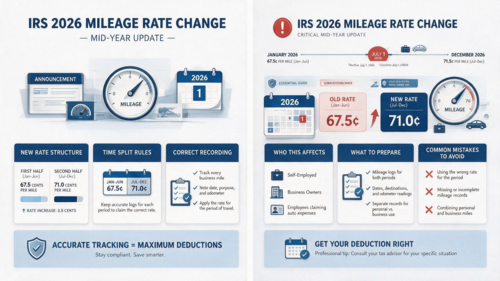
IRS Raises the Standard Mileage Rate Mid-Year: What It Means for Your 2026 Taxes
If you track business mileage, pay close attention to your calendar this year. For the first time since 2022, the IRS has adjusted the standard mileage rate in the middle of the tax year— and getting the split wrong could mean under- or over-reporting your deduction.
The New Rates at a Glance
The IRS normally sets mileage rates once, at the end of the prior year, and holds them
steady for all twelve months. Not this year. Because of a sharp run-up in fuel prices during
2026, the IRS issued a mid-year correction that creates two separate rate periods for 2026:
January 1 - June 30, 2026
• Business: 72.5 cents per mile
• Medical/moving (qualified active-duty military and certain intelligence community
members): 20.5 cents per mile
• Charitable: 14 cents per mile
July 1 - December 31, 2026
• Business: 76 cents per mile
• Medical/moving: 23.5 cents per mile
• Charitable: 14 cents per mile (unchanged — this rate is fixed by statute, not adjusted by the IRS)
Why the Mid-Year Change?
Standard mileage rates are meant to reflect the real cost of operating a vehicle —fuel, maintenance, depreciation, and insurance— so changes prompted the IRS to step in ahead of its usual annual schedule.
What This Means for Your Business
1. Split your mileage log at the midyear line. If you or your employees log business
mileage, make sure your records clearly separate miles driven before July 1 from miles
driven on or after July 1. Applying a single blended rate to the whole year will produce an inaccurate deduction or reimbursement figure.
2. Update reimbursement policies now. If your company reimburses employees using the IRS standard rate, your accounting or payroll system needs to reflect 76 cents per mile for any reimbursable trip taken on or after July 1.
3. Don't forget the leased-vehicle rule. If you use the standard mileage rate for a leased vehicle, you're required to use that method for the entire lease term, including renewals— you can't switch methods partway through.
4. Keep documentation airtight. Whichever half of the year a trip falls in, the IRS still
expects records: date, business purpose, starting/ending odometer reading or mileage and destination. A mileage tracking app that timestamps entries automatically will make this split far easier to substantiate than a manual logbook.
The Bottom Line
A mid-year mileage rate change is unusual, and it's an easy detail to miss you. Whether you're an employer reimbursing a mobile workforce or a self-employed taxpayer claiming vehicle expenses, take a few minutes now to confirm your mileage records and reimbursement policies reflect both 2026 rates correctly.
As always, if you have questions about how this affects your specific situation, our team is here to help.